
Should Women Be Cold Plunging?
The question is more complicated than you think. Cold plunges have gained popularity amongst wellness junkies, athletes and celebs. However, as more and more people take the plunge, it’s important to know why and if men and women respond the same to the icy water. I will explore how gender, hormones and physiology affect our response to cold plunging.
What exactly is cold plunging?
Cold plunging or cold immersion therapy involves submerging the body in water ranging from 4-15 °C. The cold water triggers a drop in core temperature, constriction of the blood vessels, stimulation of the nervous system, release of adrenaline, and thermogenesis, which boosts metabolism. Broadly speaking, cold plunges can be used for two reasons.
- For health and longevity: Support mood, metabolism and the neuroendocrine system (hormonal system).
- For athletic performance and recovery: To reduce inflammation and muscle soreness after intense sessions.
Whilst there is research boasting the benefits of cold plunging to elicit both results ^ most of this research is conducted in males. Therefore, the benefits of cold plunging for women are less well-known.
Temperature Matters for Women.
Men and women significantly differ in how the autonomic nervous system and thermoregulatory processes respond to the cold. Women’s fluctuating levels of oestrogen and progesterone influence the resting metabolic rate and the regulation of our core temperature. Additionally, research shows that women vasoconstrict faster than men, experiencing greater drops in core temperature during immersion, basically meaning we are more sensitive to the cold temperatures. So, when plunge to temperatures below 15 oC, our neuroendocrine system responds with a spike in sympathetic activity (“flight response”) and cortisol release. Studies suggest that over time, this can disrupt menstrual regularity, blunt thyroid function, and impair recovery.
In contrast, temperatures of 15+ °C offer a more balanced response. What happens is much the same, however, less extreme. Your core temperature still drops, triggering adrenaline release (for attention and mood), and mild shivering (a mode of thermogenesis for a metabolic boost) and increased mitochondrial biogenesis (aka more energy). This suggests that women benefit most from moderate cold exposure, sufficient to stimulate physiological adaptation, but not so extreme that it induces chronic stress or disrupts hormonal balance.
Cold Plunges and the Female Hormonal Cycle:
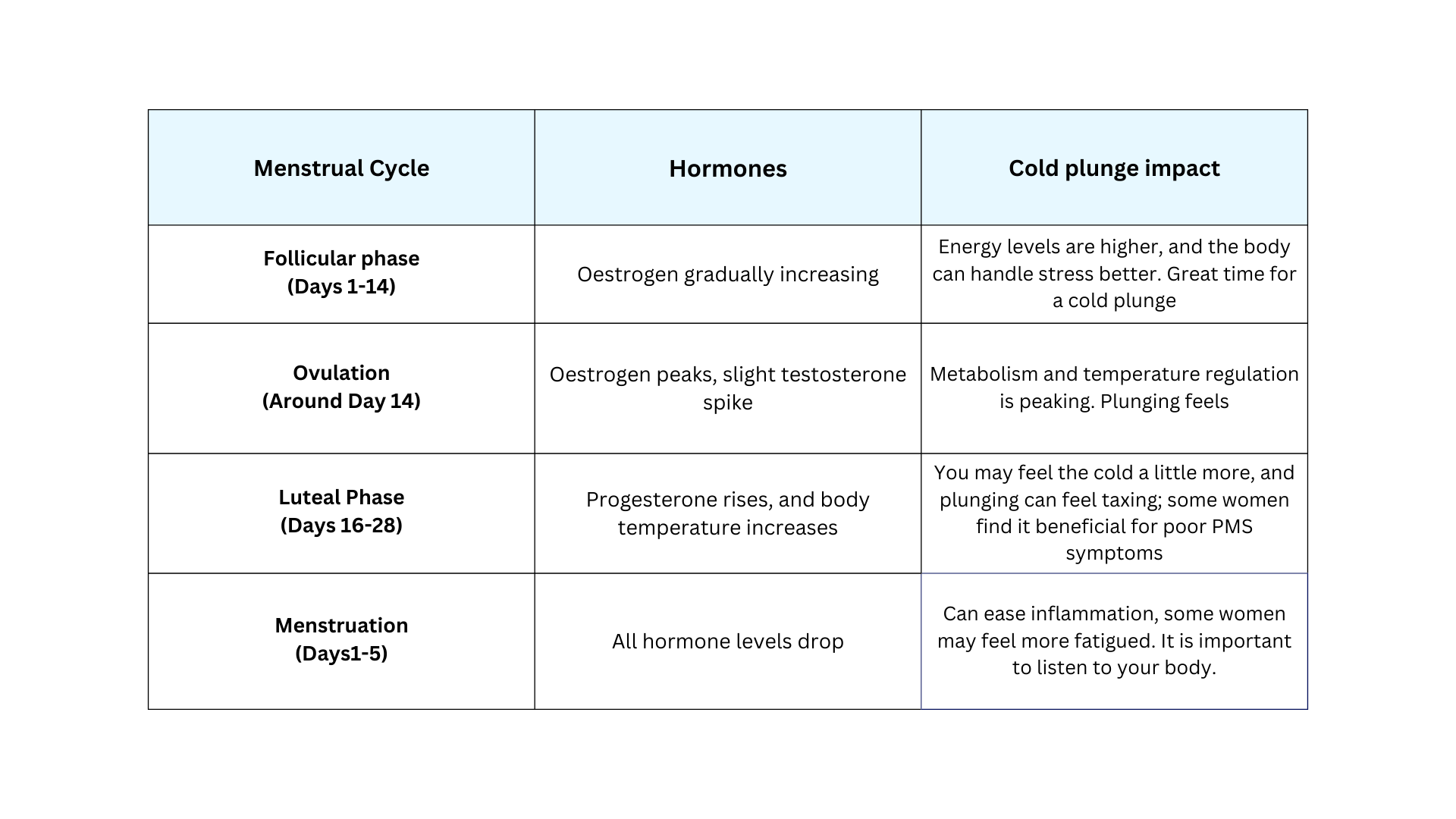
Though there is no robust science on the effects of cold plunging for women, current evidence suggests that a personalised, hormone-aware approach is likely more beneficial than simply following the “colder the better” protocols designed for men.